
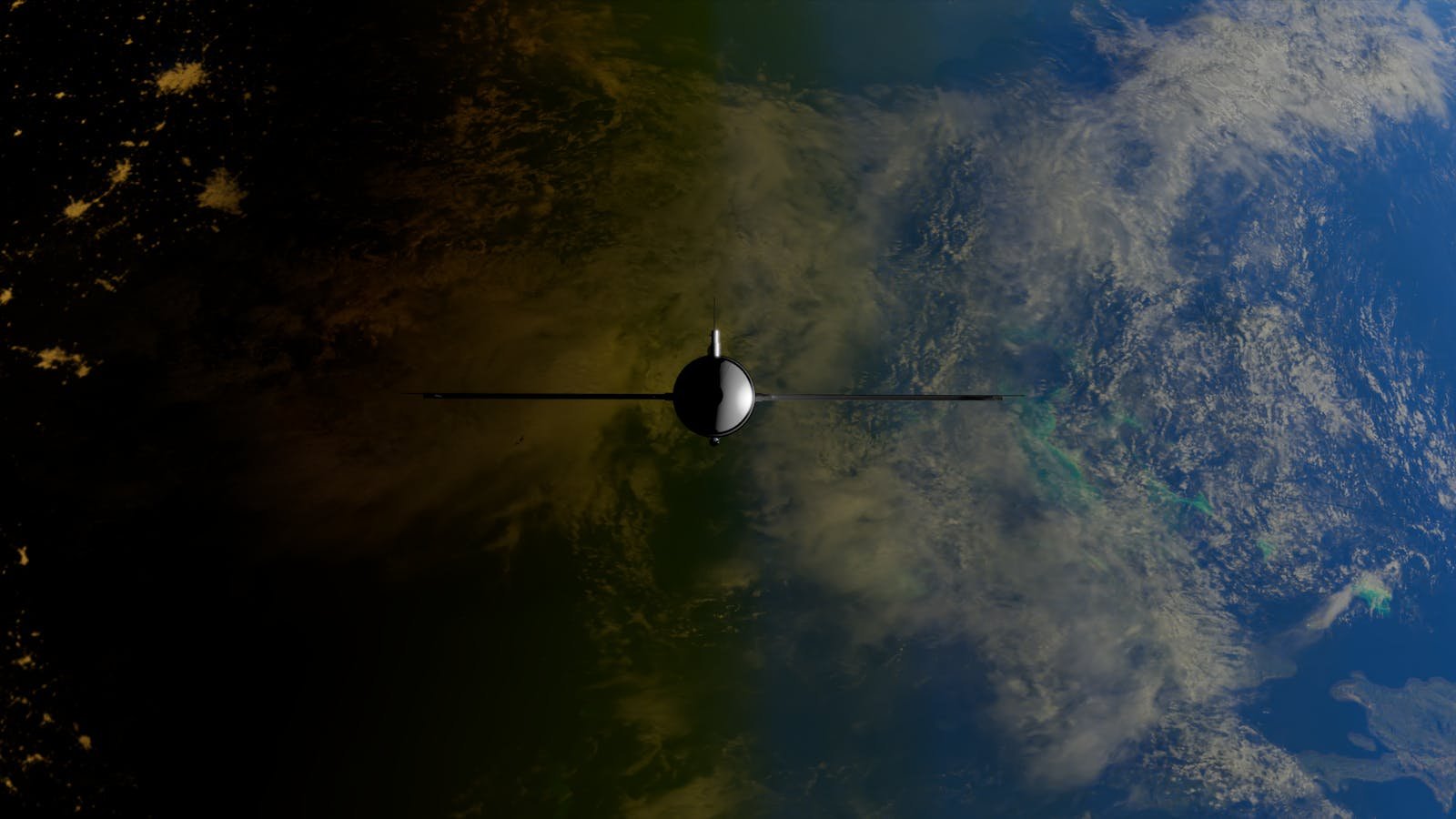
An international team of researchers has identified a new fuel-efficient route between Earth and the Moon that also avoids communications blackouts like the one the Artemis II crew experienced when their spacecraft slipped behind the far side of the Moon in April. Trajectory, published in the journal astrodynamics A group led by Alan Cardec de Almeida Jr. at the University of Coimbra uses about 58.80 meters per second less change in velocity than the most efficient route previously known, and parks the spacecraft at the L1 Lagrange point as an intermediate waypoint with continuous line-of-sight to Earth.
The savings seem modest compared to the total budget for the trip of approximately 3,343 m/s. They are not. In rocketry, each meter per second of delta-v is rapidly transformed into propellant mass at launch, which is why mission planners spend years looking for fractional improvements in trajectory design.
A hidden branch on a well-mapped highway
Spacecraft rarely keep their engines running for long periods of time. Most travel in deep space occurs along gravitational lines that physicists collectively call Interplanetary Transport Network – A network of low-energy pathways that connect orbits around planets, moons, and Lagrange points. The underlying mathematics treats gravity as a form of near-free propulsion, requiring thrusters primarily to move a vehicle from one natural trajectory to another.
Within that network, what mission designers call “variate” is a natural trajectory leading to the target orbit. Conventional wisdom held that the cheapest entry point on a lunar-orbiting spacecraft was the branch closest to Earth. The new analysis reverses that assumption. As co-author Vitor Martins de Oliveira, a postdoctoral researcher at the University of Sao Paulo, said in a statement released by Brazil FAPESP Research AgencyThe team’s systematic search revealed that entry from the opposite side, closer to the Moon, was better than the Earth-facing branch that most prior models had favored.
The answer to the problem Artemis II just ran into
The second advantage of the trajectory is that it connects directly to the experience that NASA’s Artemis II crew had just a few weeks earlier. On the fifth day of its mission’s flight, Orion passed behind the Moon for about 40 minutes, during which radio contact between the Deep Space Network and the spacecraft was cut by the Moon itself. NASA had planned a blackoutSimilar events occurred during Artemis I and Apollo, and the crews used that time to take closer observations of the far side of the Moon. But typically for crewed missions, any minute spent out of contact alters the calculus of medical emergencies, navigation anomalies and abort decisions.
A blackout is not a hardware failure that can be fixed. It’s the geometry: The Moon itself sits between the spacecraft and any Earth-based antenna. Workarounds historically have meant relay satellites, costly trajectory changes, or simply accepting silence. The Almeida group’s proposed trajectory circumvents the problem by taking the spacecraft to the L1 Lagrange point between Earth and the Moon, where it can remain in an intermediate orbit indefinitely and never lose line-of-sight with mission control. As Oliveira told FAPESP, referring to the name Artemis II: “The orbiter we propose is a solution that maintains uninterrupted communications.”
The mathematics behind the discovery
What distinguishes the new approach is the breadth of its findings. The team used a technique called the principle of functional connections, which sharply reduces the computational cost of modeling complex orbital dynamics. This lets them simulate about 30 million possible trajectories – compared to about 280,000 in earlier studies – and find solutions that local optimization methods would never find.
The trajectory itself is divided into two segments. The first takes the spacecraft from a 167 km Earth parking orbit to a stationary manifold heading to L1. The second departs L1 with an unstable manifold and transitions to lunar orbit. The non-trivial alternative is in the second section: instead of entering lunar orbit from the branch closest to Earth, the optimal entry is from the side of the Moon, where the gravitational structure of the system provides more free support.
What does the model leave out
The trajectories were calculated using the team’s model accounting only for the Earth and the Moon. Real spacecraft also feel the pull of the Sun, small disturbances from other bodies, and radiation pressure. Adding the Sun’s gravity could lead to even more efficient routes – but it would tie a given trajectory to a specific launch date, limiting the launch window. As Almeida noted in the FAPESP release, results from simulations with a fixed position of the Sun are only valid for that one date.
Thus trajectory design has always been advanced. low-energy transfer Saved Japan’s Hiten probe in 1991and later NASA’s GRAIL twins to lunar orbit, emerged from such incremental mathematical exploration of many-body problems. In Hiten’s case the savings were not theoretical: the probe reached lunar orbit on a propellant budget that would have been impossible under a conventional Hohmann transfer.
savings what to buy
The deeper story here is not a single number. It is that the lunar transportation problem, regarded by most observers since Apollo as a solved engineering exercise, still has hidden structure that systematic calculations can reveal. Half a century after Apollo 11, the cheapest known way to reach the Moon was clearly not the cheapest way.
For a cislunar economy that, on current plans, will see dozens of crewed and non-crewed flights to lunar orbit and the lunar surface over the next decade, the implications extend far beyond a paper. Almeida’s hope is that this method, not just this one trajectory, will be more widely adopted. If systematic searches through 30-million-path solution spaces become commonplace for other destinations – Mars transfers, asteroid rendezvous, outer-planet flybys – mission architectures built on traditional optimization may all be sitting on the same hidden savings.