
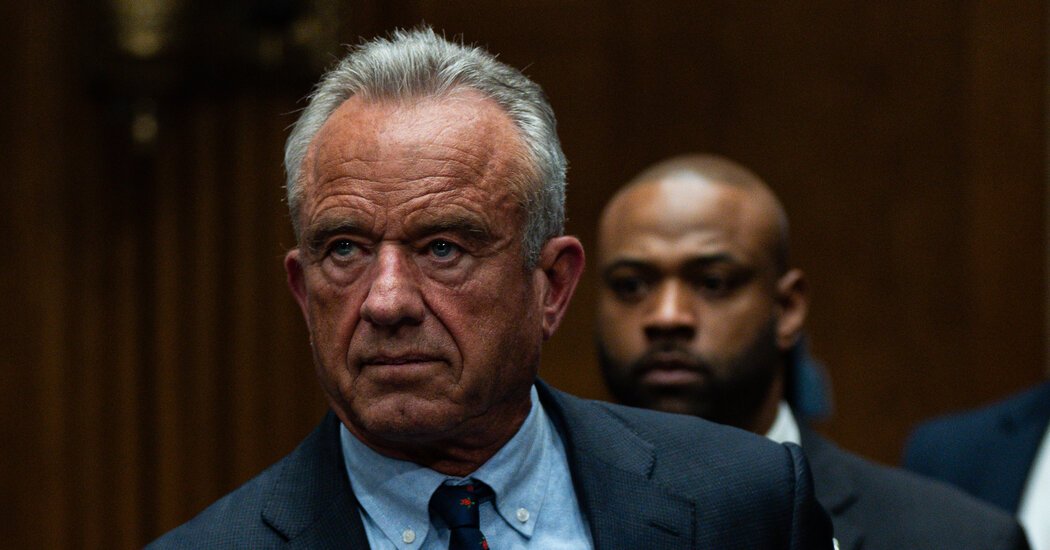
The Trump administration’s decision this week to put Health Secretary Robert F. Kennedy Jr. in charge of special education programs has drawn sharp reaction from advocates for students with disabilities who say the move will harm children and that his views on autism make him ineligible for the job.
Mr Kennedy said earlier this year that children with autism would never hold a job, play baseball or go on dates. He quickly walked back his comments, saying he was speaking only about the most serious cases – only to insist the next day that special education should be moved to his department. “They are health-related programs rather than specifically educational programs,” Mr. Kennedy said.
Advocates for students with disabilities said Mr. Kennedy’s comments show how the change puts students with disabilities at risk of being seen as medical conditions to be treated rather than boys and girls who are being educated.
“This reflects a fundamental lack of understanding about who children with disabilities are, how they can succeed in school and how they can have a bright future,” said Katie Ness, chief executive of The Arc, a national support group for people with intellectual and developmental disabilities.
The move is part of an extraordinary effort by the Trump administration to dismantle the Education Department, which supporters have said would improve government efficiency, lead to better outcomes for students and fulfill Republicans’ decades-old promise to close the agency.
Congressional approval is required to completely close the department, which has focused on other matters this term. Meanwhile, the Trump administration has transferred tens of billions of dollars in Education Department programs to six different federal executive agencies, including Health and Human Services.
Courtney Parella Spencer, the top spokeswoman for the Department of Health, said Mr Kennedy “strongly agrees” with the idea that “a child’s disability is not viewed as a medical condition that should be treated.” He said health department experts have “significant accumulated knowledge of serving individuals with disabilities” and will incorporate their expertise into programs to ensure that students’ needs are met.
“This partnership is about improving federal support systems for children and families,” Ms. Spencer said, “while fully preserving the legal protections and educational rights guaranteed under federal law.”
Congress can block changes that some members oppose, but such a move does not have widespread support.
Advocates for students with disabilities have struggled for decades to convince local schools, state leaders, and federal lawmakers to educate children with a variety of disabilities, including physical limitations such as deafness and blindness, and neurodevelopmental disorders such as autism, along with other students. That effort culminated in 1998 with changes to the Individuals with Disabilities Education Act, which guaranteed students with disabilities the opportunity for a free, appropriate public education.
But advocates said they have recently had to redouble their efforts to protect the rights of children with disabilities to receive a quality public education.
Last year, in an interview on Fox News during her first week as education secretary, Ms. McMahon failed to name landmark legislation for students with disabilities. For many, the moment underlined the lack of experience that Ms. McMahon, a former pro-wrestling executive, brought to the job.
Edward M. Kennedy Jr., a civil rights advocate for people with disabilities and Secretary Kennedy’s cousin, said in an email that he shared concerns about moving special education programs to the Department of Health and Human Services.
His biggest concern, he said, was “the policy and philosophical shift from viewing children with disabilities as having strengths, abilities, and a right to be integrated into classrooms.
Mr. Kennedy, the health care regulatory lawyer, said, “This change at HHS returns to an outdated, ‘medical model’ of disability policy that viewed children with disabilities as ‘sick’ and in need of health care, not education.”
But concerns cross partisan lines.
President George W. Margaret Spellings, former Secretary of Education under Bush, described Secretary Kennedy’s comments as “head-scratching” and said she was deeply concerned about the confusion caused by fragmented education services across the federal government.
“I struggle with the logic behind all of this,” Ms. Spellings said of dismantling the Education Department. “Is it just to take a photo of the lock on the Department of Education building? To jump to the conclusion that this will increase student achievement, I don’t agree.”
Beyond those broader concerns, there are particular concerns about Mr. Kennedy, who has rejected much of the science behind vaccines and autism.
Maria Towns, president of the American Association of People with Disabilities, said that Mr. Kennedy’s views on autism, ADHD and mental illness and his embrace of unconventional treatments concern her. Ms. Towns has cerebral palsy and said she benefited from federal protections as a student.
“Will children with autism be forced to engage in practices that we know don’t work?” Ms. Towne said. “Children with disabilities already receive medical care from their doctors and health care practitioners. They deserve the chance to be students and engage in the classroom like any other child.”
Stephanie Smith Lee, who during the George W. Bush administration ran the Office of Special Education Programs, which is being moved to the Department of Health and Human Services, said the change created more bureaucracy and risked hurting educational opportunities for students.
“Children with disabilities are not diagnosed,” said Ms. Smith Lee, now co-director of policy and advocacy at the National Down Syndrome Congress. “These are students first and they need to be educated and they need to be educated alongside their general education peers – and the federal offices that oversee education need to be in the same department.”
Ms. Smith Lee said she hoped Republican leaders who control Congress would block the changes.
Republicans in the House and Senate have shown little appetite for opposing the Trump administration’s moves. But some skepticism was expressed Wednesday in the Senate Committee on Health, Education, Labor and Pensions, which oversees both the health and education departments.
Senator Bill Cassidy, chairman of the panel, said he opposed moving special education programs to the Department of Health and Human Services.
Mr. Cassidy said at the hearing that he would work with Senator Tim Kaine, Democrat of Virginia, on legislation aimed at blocking the move, which the committee will consider at its meeting in July. But Mr. Cassidy is a short-term member of Congress; He recently lost his Republican primary race in Louisiana to a Trump-backed challenger.
“I have publicly committed to working with them to find something for the next markup in July that addresses everyone’s concerns,” Mr Cassidy said.