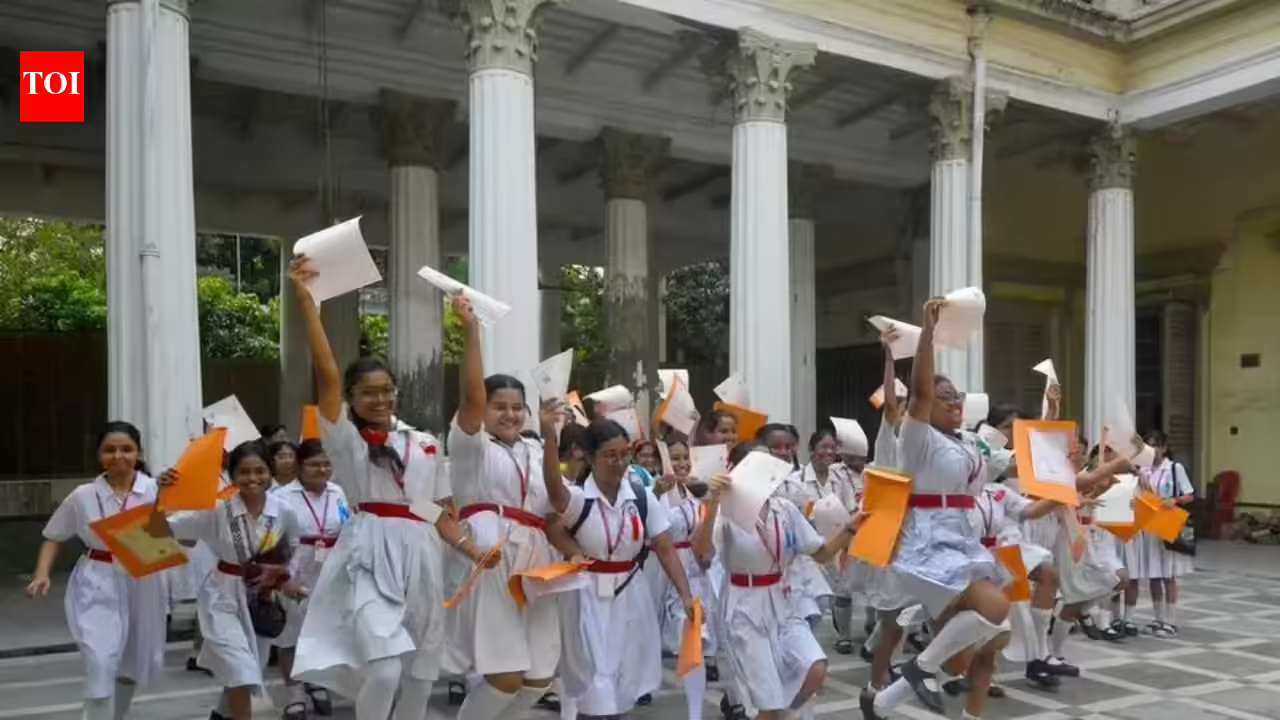
Kolkata: One hundred and thirty-one students made it to the secondary top 10 list this year – the highest in recent years – with Avirup Bhadra of Sarada Vidyamandir (Raiganj) High School securing the first position with 698 marks (99.7%). The results of Madhyamik examination were declared on Friday. Last year, there were 66 students in the top 10 ranks. The pass percentage in the state board Class 10 exam this year increased marginally to 86.8% from 86.6% last year, as 8,06,015 out of 9,53,753 students passed the exam. More girls than boys appeared for the exam but the success rate of girls (84.5%) was lower than that of boys, 89.5%. Although the marks in second language, mathematics and physics declined, students scored more than 90% marks in geography, life sciences, history.The top 10 positions are occupied by 14 students from North Dinajpur, including Bhadra, 23 from East Midnapore, 11 from South 24 Parganas – seven from RKM Narendrapur among them – nine from Purulia, eight from North 24 Parganas, 14 from Bankura, nine from Hooghly, seven from Cooch Behar, six from Birbhum, five from Malda, five from East Burdwan, four from Howrah, Three from Nadia, three from South Dinajpur, three from West Midnapore, three from Murshidabad, two from Alipurduar, one from West Burdwan and one from Jhargram. But among the 131, there was none from Kolkata district, surprising heads of major schools in the city. Ruling out the possibility of bias against Kolkata students, West Bengal Board of Secondary Education chairman Ramanuj Ganguly said the results were purely based on performance. “We cater to a wide range of students, many of whom are first-generation learners. It would be unfair to compare them with other boards, where very high scorers come from Kolkata,” he said. “We do not have MCQs, which are prominent in other board papers.”But teachers from Kolkata state schools highlighted the difference in teaching-learning and teaching-questioning patterns. Saugata Basu, general secretary of the West Bengal Government School Teachers Association, said, “This time, questions in many subjects including life sciences and mathematics were a bit difficult as some were application based. But students hardly practice such questions in class.” Shortage of teachers and reduced number of teaching days due to long holidays also had an impact.“Subhrajit Dutta, headmaster of Hindu School, attributed the declining number of high scorers in the city to reliance on technology, especially AI. Trying to find a solution, Partha Pratim Baidya, principal of Jadavpur Vidyapeeth, felt that more teacher orientation programs could change this trend. “The question pattern is changing everywhere, so we have to change our mindset too and prepare students accordingly. Practice was not enough for the number of application-based questions this year.” Those who scored 90% and above included 129 out of 134 students from RKM Narendrapur, 10 out of 166 from Jadavpur Vidyapeeth, 36 out of 194 from Patha Bhawan, 18 out of 102 from Jodhpur Park Boys and 26 out of 216 from Scottish Church Collegiate School. Only four out of 126 students in Hindu School and Ballygunge Govt scored 90% and above marks and seven out of 101 respectively. Swami Ishteshanand, headmaster of RKM Narendrapur, said, “We focus on practice as our students sit for tests. This helps them to score well.”