
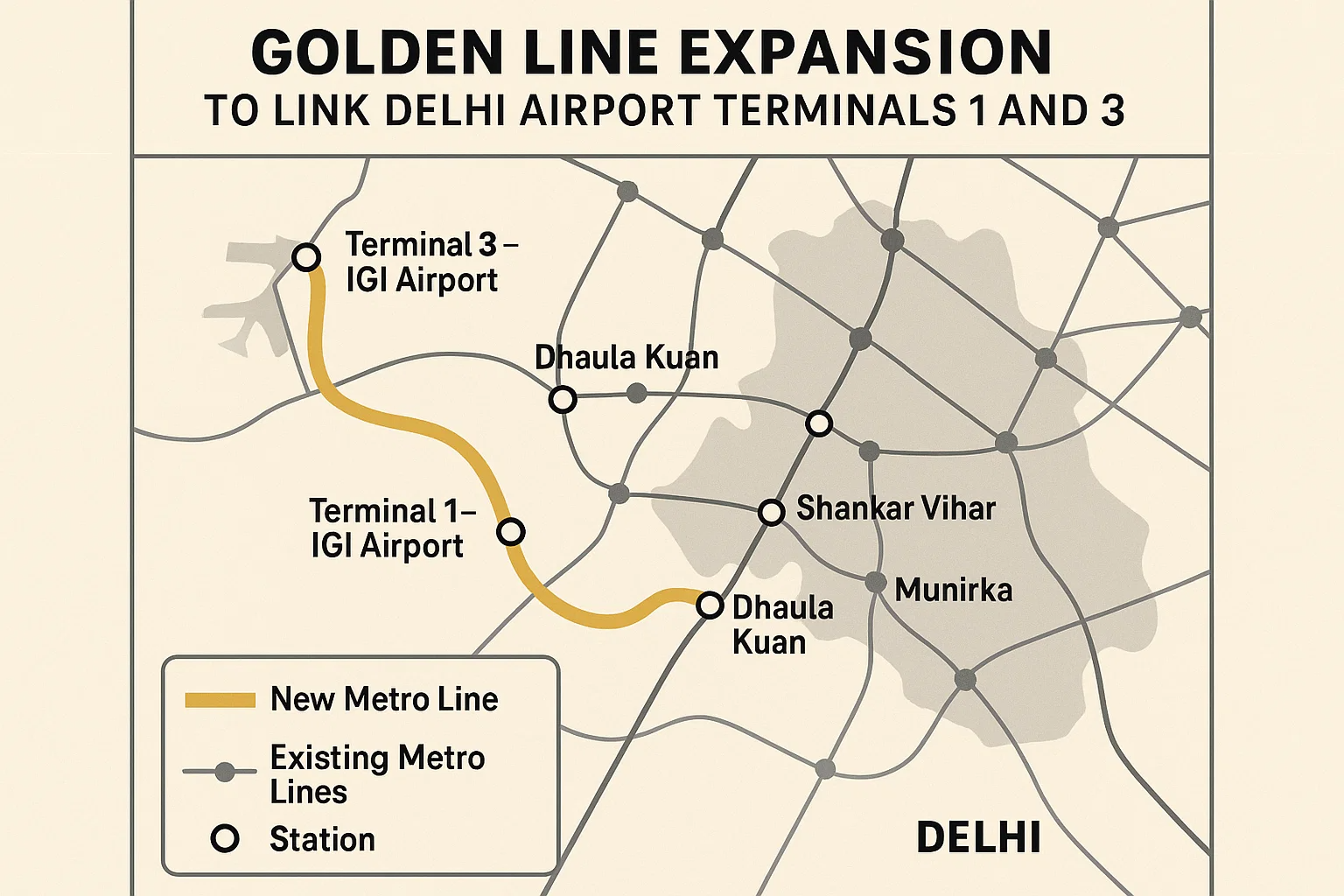
The national capital’s airport infrastructure is set to get a major boost. The Golden Line — a key corridor of the Delhi Metro Rail Corporation (DMRC) under Phase IV of the metro expansion — is planned to integrate directly with Indira Gandhi International Airport (IGIA), linking Terminal 1 (T1) with Terminal 3 (T3) via the Aerocity hub and enhancing airport-terminal connectivity like never before.
According to statements from Delhi International Airport Ltd (DIAL) CEO Videh Kumar Jaipuriar, the Golden Line corridor will be extended to include T1, thereby creating a seamless rail link between T1, Aerocity and T3. This comes in response to the current gap: while T2 and T3 lie adjacent and share connectivity, T1 remains several kilometres away and lacks a direct metro link. The new expansion aims to bridge that gap.
Below, we explore in depth what this means, the project details, benefits, challenges, timelines, and how airport passengers and commuters stand to gain from the Golden Line expansion focusing on airport connectivity.
1. Current Situation: Airport Connectivity at IGIA
At present, IGIA, operated by DIAL, handles an enormous volume of passengers — over 100 million annually across its three terminals and four runways. T2 and T3 are adjacent and share convenient access; T3 is served by the Airport Metro Express (Orange Line) and T1 is connected via the Magenta Line, but there is no direct metro rail link between T1 and T3. Passengers who land or depart via one terminal and need to reach the other must travel by road, which can be time-consuming and subject to Delhi’s traffic conditions.
In simpler terms:
- Terminal 3 (T3) → has metro access via Orange Line (Airport Express)
- Terminal 1 (T1) → has metro access via Magenta Line
- But T1 ↔ T3 connection by metro is missing, meaning the gap remains for inter-terminal transfer by rail.
Hence the need for the Golden Line Delhi Airport connectivity becomes very clear: by linking T1 directly to Aerocity / T3 zone, the entire airport complex stands to gain in terms of convenience, speed and multi-modal connectivity.
2. What is the Golden Line and How Does It Fit in Phase IV?
The Golden Line is one of the priority corridors under Delhi Metro’s Phase IV expansion. Here are the key facts:
- The line is designated Line-10 in the DMRC system.
- The route covers approximately 23.622 km from Aerocity to Tughlakabad.
- Of this length, about 4.279 km is elevated, and 19.343 km is underground.
- The corridor will feature 15 stations.
- The Golden Line was earlier called the “Silver Line” and then briefly “Gold Line” before being named Golden Line.
- Tunnelling work and major construction milestones are already underway, with the DMRC completing major sections of the underground stretch.
The alignment from Aerocity to Tughlakabad essentially runs through South Delhi, connecting dense residential and commercial zones, with the airport as a strategic node. The extension to T1, as indicated by DIAL, would integrate the airport’s terminals with the metro network in a way that is currently missing.
3. How the Golden Line Will Link T1 and T3 at IGIA
As per the interview with Videh Kumar Jaipuriar:
“The Golden Line was earlier supposed to come up to the Aerocity. We have convinced the DMRC to extend it up to T1. So, that will actually act as one of the metro lines which will connect from T1 to Aerocity and from Aerocity, we have got the airport line.”
This statement indicates that the extension (or special alignment) will directly link T1 with Aerocity, which already lies close to the airport zone and T3. In effect, a passenger arriving at T1 will be able to board the Golden Line metro to Aerocity and then transfer or directly reach Terminal 3 via the metro/other transport modes.
Additionally, DIAL plans to introduce an elevated cum at-grade Automated People Mover (APM) or “air train” to link T1 with T2 and T3, complementing the metro expansion. This multi-modal integration would ensure that the airport complex becomes a seamless transit hub.
4. Table: Key Project Details of Golden Line & Airport Link
| Aspect | Detail | Importance for Airport Connectivity |
|---|---|---|
| Corridor Name | Golden Line (Line-10) | Official metro line under Phase IV |
| Route Length | ~23.622 km (Aerocity ↔ Tughlakabad) | Solid backbone for South Delhi connectivity |
| Elevated / Underground | ~4.279 km elevated + ~19.343 km underground | Minimises disruption in urban areas |
| Number of Stations | 15 | Provides multiple access points |
| Strategic Extension | T1 ↔ Aerocity ↔ T3 (via metro) | Direct rail link between airport terminals |
| Multi-modal Integration | Metro + APM (air train) proposed by DIAL | Enhanced transit experience inside airport |
| Expected Completion | Target around March 2026 for corridor. | Timely arrival will benefit passengers & airport operations |
5. Benefits of Golden Line Delhi Airport Connectivity
- Seamless Inter-Terminal Movement: With a direct metro (Golden Line) linking T1 and Aerocity (and thereby T3), passengers will experience much faster transfers, reducing reliance on road links and shrinking transfer times.
- Improved Airport Access: Residents of South Delhi, and areas along the Tughlakabad corridor, will get direct metro access to the airport complex, boosting convenience and reducing travel stress.
- Reduced Road Traffic & Emissions: Fewer road transfers between terminals and to/from the airport will lower traffic congestion, fuel consumption and pollution in the airport precinct.
- Multi-Modal Transit Hub: With the integration of metro, APM/air-train and other shuttle services, IGIA will become a modern multi-modal terminal nexus — making passenger experience smoother and more efficient.
- Boost to Airport Capacity & Efficiency: As IGIA handles over 100 million passengers annually, better connectivity will support throughput, minimize delays, and enhance the airport’s operational flexibility.
- Real-Estate & Urban Growth Impact: Areas along the Golden Line corridor (Aerocity, Vasant Kunj, Kishangarh, etc.) will witness property value appreciation, commercial growth, and improved public transport-oriented development.
6. Challenges & Considerations
- Timelines & Delays: While the corridor is under construction, target completion is around March 2026 for some stretches. Any delay could impact the inter-terminal link plans.
- Coordination Between Agencies: The project involves DIAL, DMRC, RRTS, and airport terminal management. Seamless coordination is key for the multi-modal link to work effectively.
- Construction Complexities: Underground tunnelling in dense corridors (19.3 km underground segment) poses technical, environmental and safety challenges.
- Passenger Transfer Logistics: Even after metro access, how smoothly a passenger moves from metro to terminal, with luggage, check-in, security etc., needs planning. The APM/air train element plays a critical role here.
- Cost & Funding: The expansion of the network and the airport-linked corridor demand major investment; delays or cost overruns could hamper execution.
- User Awareness: Once operational, passengers need to be aware of the new link, routing, ticketing and transfer options for maximum benefit.
7. Timeline – What to Expect and When
- March 2025: Major tunnelling breakthrough achieved on the Aerocity-Tughlakabad stretch of Golden Line.
- June 2025: DMRC announces milestone completion of 0.792 km tunnel on the corridor.
- Early to Mid-2026 (Expected): Golden Line corridor completion and potential opening of Aerocity to T1 segment (subject to approvals and construction pace).
- Subsequent Phase: Integration of APM/air train link at IGIA linking T1, T2 and T3 as proposed by DIAL.
- Post Opening: Real-world usage, monitoring, and adjustments for passenger flow, inter-modal transfer, station integration.
8. Impact on Passengers & Airport Users
For the traveller, the Golden Line Delhi airport connectivity means:
- If you arrive at Terminal 1 and need to depart from Terminal 3 (or vice versa), you will have a metro option rather than depending on a shuttle bus or taxi.
- Commuters living along South Delhi corridors will find route to IGIA far easier, boosting metro ridership and reducing road congestion.
- Business travellers, airport staff, and residents of Aerocity, Vasant Kunj, Kishangarh and adjoining zones will gain enhanced connectivity, reducing travel time and cost.
- The airport itself will be able to manage passenger flows more smoothly, especially during peak hours, as transfers become less path-constrained.
In broader terms, the addition of the Golden Line enhances the connectivity ecosystem around the airport — metro, people mover, shuttle buses — all converging to deliver a modern travel experience.
9. Why Focus on Terminal 1 to Terminal 3 Link?
While T2 and T3 are adjacent and share access, Terminal 1 has historically been slightly isolated in terms of metro connectivity. Given the volume of passengers, the need for a direct and efficient metro link becomes more important than ever. By enabling the Golden Line extension to T1, the airport operator DIAL and DMRC are addressing a longstanding mobility gap.
Moreover, the airport’s usage of multiple terminals, the growth of Aerocity as a business & hospitality hub, and the increasing passenger volumes mean that inter-terminal connectivity is no longer a luxury but a necessity. Modern airports globally aim to offer multi-modal, seamless connectivity; the Golden Line project is India’s step in that direction.
10. FAQs – Golden Line Delhi Airport Connectivity
Q1. What exactly is the Golden Line in the Delhi Metro network?
A1. The Golden Line (Line-10) is a corridor under the Delhi Metro Phase IV expansion, covering about 23.622 km between Aerocity and Tughlakabad with 15 stations.
Q2. How will the Golden Line link IGI Airport Terminals 1 and 3?
A2. According to DIAL, the Golden Line extension will reach Terminal 1 via Aerocity, enabling a direct metro link between T1 and the airport complex (including T3).
Q3. When is the Golden Line expected to be complete and operational?
A3. The expected completion date for major stretches is around March 2026, though final operational dates will depend on construction, testing and approvals.
Q4. Will there be other modes of connectivity besides the metro for IGIA?
A4. Yes — DIAL also plans an elevated/at-grade Automated People Mover (APM) or “air train” linking T1, T2 and T3, which will complement the metro link.
Q5. What are the benefits for airport passengers when the Golden Line link is in place?
A5. Passengers will enjoy faster transfers between terminals, reduced dependence on road shuttles, smoother access to/from metro stations, and improved travel experience overall.
Q6. Are there any unique features of the Golden Line project?
A6. Yes — stations such as Khanpur and Ambedkar Nagar on this corridor will use a “split-station” design (platforms in separate buildings connected by foot-bridge) — a first for Delhi Metro.
11. Summary
In summary, the Golden Line Delhi airport connectivity initiative stands out as a pivotal infrastructure upgrade for New Delhi. The extension of the metro link to Terminal 1 of IGIA, integrated with the existing Aerocity-T3 corridor, and the proposed air-train system, will transform the passenger experience by making the airport complex truly multi-modal.
This project addresses a critical gap in the airport’s connectivity network, promises to reduce travel time, ease passenger transfers, support real-estate growth around metro stations, and enhance the entire region’s urban transport ecosystem. While challenges exist—particularly around construction complexity and timelines—the benefits are substantial and will resonate for years to come.
For both frequent flyers and daily commuters alike, keeping an eye on the Golden Line’s progress is worthwhile, given how it will reshape mobility in one of India’s busiest transit zones.
More Related Post