
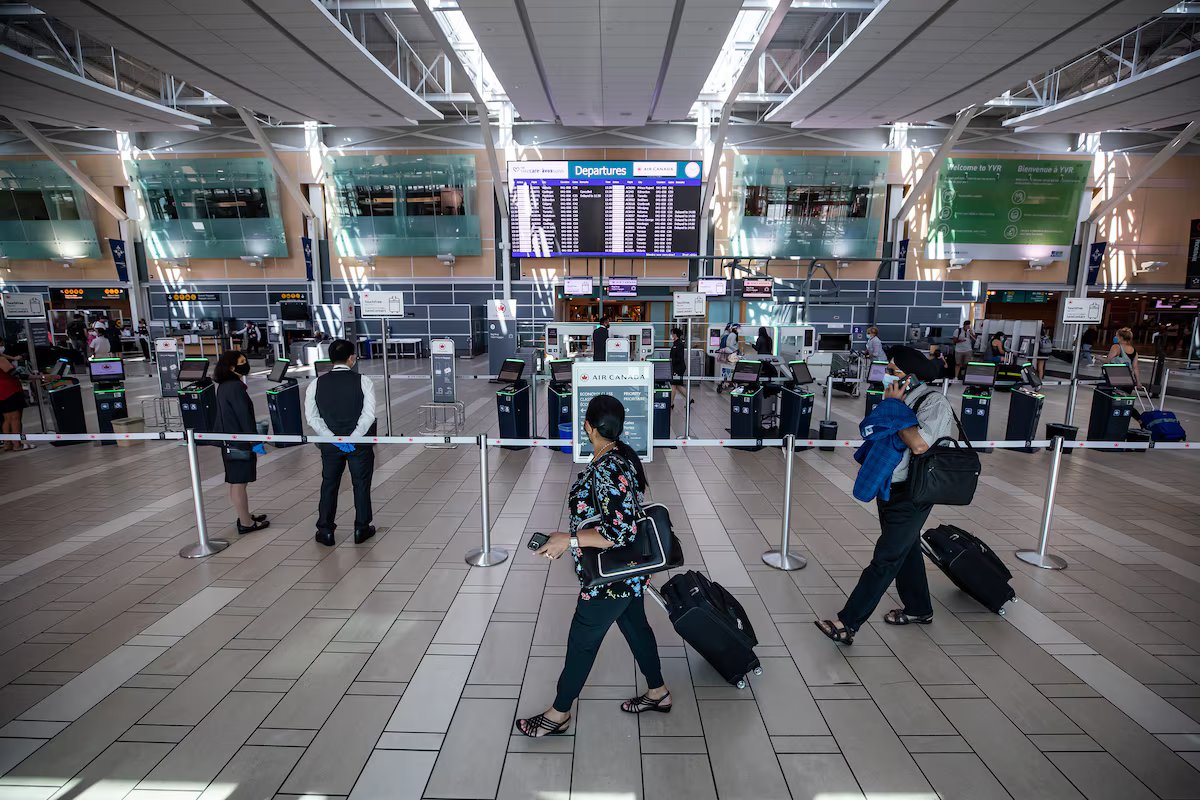
Passengers walk through the Air Canada domestic check-in area at Vancouver International Airport in July, 2021. The top court considered the pandemic travel rules to be within reasonable limits on the rights and freedoms in section 1 of the Charter.Darryl Dyke/Canadian Press
In the early days of the pandemic, in May, 2020, Kimberly Taylor’s mother, Eileen, died in St. John’s of natural causes at the age of 75.
Kimberly lived in Halifax and wanted to attend the small memorial service but due to travel restrictions, the Newfoundland government denied her initial request.
She missed the burial which her father, sister and niece attended. “I was denied the opportunity to join my family in mourning my mother,” Ms Taylor said earlier this week.
Immediately after leaving the service, Ms. Taylor launched a legal challenge in conjunction with the Canadian Civil Liberties Association. He asserted that the strict travel restrictions violated mobility rights guaranteed by section 6 of the Charter of Rights and Freedoms within Canada.
On Friday morning, all nine justices of the Supreme Court of Canada provided a detailed view of Canadians’ Charter mobility rights. Supreme Court gave its verdict Ms. Taylor’s rights were in fact violated by Newfoundland’s pandemic rules. However, due to the “grave emergency”, the Court considered the pandemic travel rules to be within reasonable limits on the rights and freedoms in section 1 of the Charter.
“This is a great decision – and an important one,” said Jessica Kuredjian, Cassels’ lawyer in Toronto who was also a lawyer for the intervener in the case, the Canadian Constitution Foundation. “This is a very humanitarian case. It’s a great example of where Charter rights impact the real rights of everyday citizens.”
The judgment – spanning over 200 pages and 50,000 words – is significant on various fronts: political powers, constitutional rights, legal analysis.
First, it will serve as a precedent for the scope of government actions and restrictions during potential future health emergencies. The court took a respectful approach, deeming Newfoundland’s strict travel restrictions justified, while saying other less stringent measures could have achieved the same goal of limiting the spread of the deadly virus.
While all the judges agreed on the main points, the decision split into several camps on the analysis of the Charter.
In a ruling written by Judges Andromache Karakatsanis and Sheila Martin, a majority of five judges said the deaths and medical-scientific unknowns at the start of the pandemic created “an exceptionally difficult situation where rapid decisions had to be taken to attempt to protect health and minimize further loss of life.”
It is the latest major court decision that underlines individual rights against government powers that stem from major decisions taken during the pandemic. A month earlier, the Federal Court of Appeal had ruled that the federal government’s use of the Emergency Act in 2022 to suppress large protests was not legally justified.
Friday’s decision is also an important contribution to the legal histories that detail aspects of the 1982 Charter of Rights. Several sections of the Charter have been the subject of extensive legal disputes and numerous court decisions over the years. But Section 6, mobility rights, is not one of them.
“There was really a lack of jurisprudence on this topic,” said Anais Bussières McNicol, director of the civil liberties association’s fundamental-liberties program.
The decision on pandemic travel restrictions is effectively the Supreme Court’s first in-depth consideration of the meaning of section 6 of the Charter as it relates to Canadians’ general freedom to move around the country.
The majority of five judges wrote of the “liberal protections” that must be seen in the words of the Charter to protect those rights. On the concept of mobility, he invokes rights in common law dating back almost a millennium to the 1200s, and even further back to “ancient customs”.
He also said that mobility rights play a unique role in the “nation-building objective” of the Charter.
Specifically, the majority concluded that section 6(1) “gives citizens the right to move throughout Canada without restriction.”
This is important because Text of section 6(1) No such right is explicitly stated: “Every citizen of Canada has the right to enter, remain and leave Canada.”
But the majority analysis considered it to involve movement within the country.
Despite the Court’s unanimity in the case on the main questions of broad mobility rights and reasonable limits, it is divided on how section 6 should be read.
In the lead partial dissent, written by Justices Nicholas Cassirer and Mahmoud Jamal and joined by Chief Justice Richard Wagner, the group said that section 6(1) protects rights related to international mobility for Canadian citizens.
Instead he said it is section 6(2) that protects unrestricted mobility throughout Canada for both citizens and permanent residents.
Text of section 6(2) Talks about people being able to move to other provinces and reside and work throughout the country.
The majority of five judges also concluded that section 6(2) guarantees mobility rights without restriction.
“This is a huge victory for freedom of movement,” said Christine Van Geyn, executive director of the Canadian Constitution Foundation. “It’s one thing to say that your section 6 right of mobility may be limited under section 1. It’s quite another to say that the right to move freely around the country under section 6 does not exist at all. This was an outrageous position by the government and they completely lost.”
The Newfoundland government did not immediately respond to a request for comment Friday.