
Recent Price Movements and Market References
As of March 4, 2026, Bharti Airtel stock closed at ₹1,873.35, down 0.34% from its previous close of ₹1,879.75. The intraday range witnessed a high of ₹1,896.00 and a low of ₹1,842.20, indicating some volatility within the session. The stock remains comfortably above its 52-week low of ₹1,568.30, but is still below its 52-week high of ₹2,174.70, indicating a wide trading band over the last year.
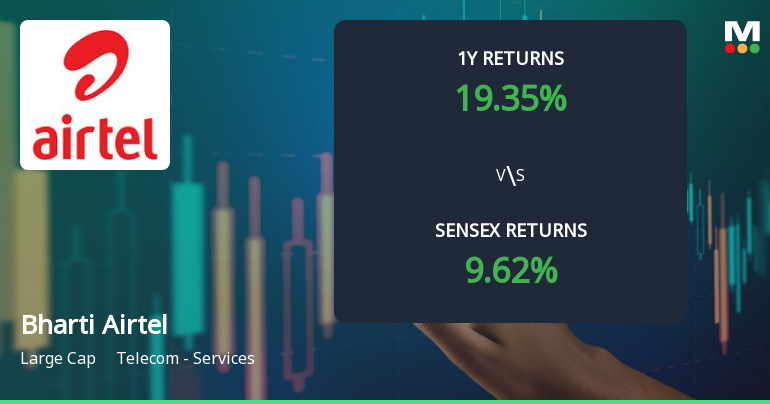
Comparatively, the stock has underperformed the broader Sensex index in the short term. Bharti Airtel fell 6.20% last week, while the Sensex fell 3.67%. Similarly, the stock’s one-month return was -4.69% against the Sensex’s -1.75%, and year-to-date loss is -11.03% against the Sensex’s -5.85%. However, long-term performance remains strong, with a 1-year return of 19.35% compared to the Sensex’s 9.62%, and an impressive 10-year return of 524.73% compared to the Sensex’s 230.98%.
Technical trend change: from sideways to mildly bearish
The technical trend for Bharti Airtel has shifted from a sideways pattern to a mild bearish pattern, indicating a subtle shift in market sentiment. This change is confirmed by several momentum and trend-following indicators.
The Moving Average Convergence Divergence (MACD) indicator, a key momentum oscillator, shows a bearish signal on the weekly charts and a mild bearish trend on the monthly charts. This shows that while the short-term momentum is weakening, the long-term trend is only slightly negative, indicating the possibility of consolidation or a gradual decline.
Meanwhile, the Relative Strength Index (RSI) remains neutral on both the weekly and monthly timeframes, giving no clear overbought or oversold signals. The lack of directional RSI signals means that the stock is not currently in the extreme momentum phase, which could mean that the market is waiting for new catalysts.
Bollinger Bands and Moving Averages: Divergent Signals
Bollinger Bands, which measure volatility and potential price extremes, paint a mixed picture. On the weekly chart, the bands indicate a bearish trend, which suggests that the stock price is moving towards the lower bands and may face downward pressure. Conversely, the monthly Bollinger Bands show mild bullish signals, indicating long-term support and the possibility of higher prices.
The daily moving averages provide a mildly bullish outlook, with the stock price slightly above key short-term averages. This suggests that despite recent weakness, there remains some underlying buying interest and technical support at these levels. The interplay between daily bullish moving averages and weekly bearish momentum highlights market volatility, where short-term optimism is tempered by widespread caution.
Additional Momentum Indicators: KST, Dow Theory and OBV
The No Sure Thing (KST) indicator, which aggregates several measures of rate of change, aligns with a bearish weekly and mildly bearish monthly trend, strengthening the weak momentum view. Dow Theory analysis also supports a mild bearish trend on both the weekly and monthly charts, indicating that the stock may be in the early stages of a corrective phase.
On the other hand, on-balance volume (OBV) shows no clear trend on the weekly or monthly time-frames, suggesting that volume flows have not conclusively confirmed buying or selling pressure. This lack of volume confirmation increases uncertainty over the stock’s immediate direction.
Mojo Score and Rating Update
Bharti Airtel’s current Mojo score is 52.0, indicating a Hold rating, indicating a decline from the previous Buy rating until December 29, 2025. Market cap remains at Grade 1, indicating large-cap positioning but with limited recent momentum. This rating adjustment aligns with technical indicators indicating a shift toward caution and a more defensive stance among investors.
Investors should note that while the stock’s fundamentals and long-term growth prospects remain intact, technical signals suggest a period of consolidation or a mild correction is underway. This is in line with the stock’s recent underperformance relative to the Sensex in the short term.
Implications for investors and the outlook
The change in technical momentum in Bharti Airtel suggests that investors should exercise caution in the near term. The mildly bearish weekly MACD and KST indicators, coupled with the decline in Mojo Grade, point to a possible period of price consolidation or minor decline. However, the absence of extreme RSI readings and mildly bullish daily moving averages suggest that the stock is not in a strong downtrend and may find support around current levels.
Long-term investors can find reassurance in the stock’s strong multi-year returns, which have significantly outperformed the Sensex over 3, 5 and 10 year periods. The 10-year return of 524.73% versus Sensex’s 230.98% underlines Bharti Airtel’s historical resilience and growth potential in the telecom sector.
Traders and technical analysts should monitor key support levels near 52-week low ₹1,568.30 and resistance levels around 52-week high ₹2,174.70. A sustained break below the short-term moving average could confirm a deep correction, while a bounce above the daily average and monthly Bollinger Bands could signal renewed bullishness.
Overall, the mixed technical signals call for a balanced approach, combining caution on downside risks with recognition of the stock’s underlying strength and sector leadership.
Summary of Technical Indicators
- MACD: Weekly Bearish, Monthly Mild Bearish
- RSI: Neutral on weekly and monthly
- Bollinger Bands: Weekly bearish, monthly mild bullishness
- Moving Average: Daily Mild Bullishness
- KST: Weekly Bearish, Monthly Mild Bearish
- Dow Theory: Weekly and Monthly Mild Bearishness
- OBV: No clear trend on weekly and monthly
conclusion
Changes in Bharti Airtel Limited’s recent technical parameters reflect a subtle change in price momentum, with a slight bearish bias in the short to medium term. While some indicators warn of potential weakness, others suggest the stock will remain supported and could stabilize. Investors should look at these mixed signals carefully, considering both the technical outlook and the company’s strong fundamental track record before making portfolio decisions.
Limited period only. Only Rs. Start in. Rs.16,999 – Get MojoOne for 2 Years + 1 Year Absolutely FREE! (72% off) Get 72% off →