
Leh, New Delhi:
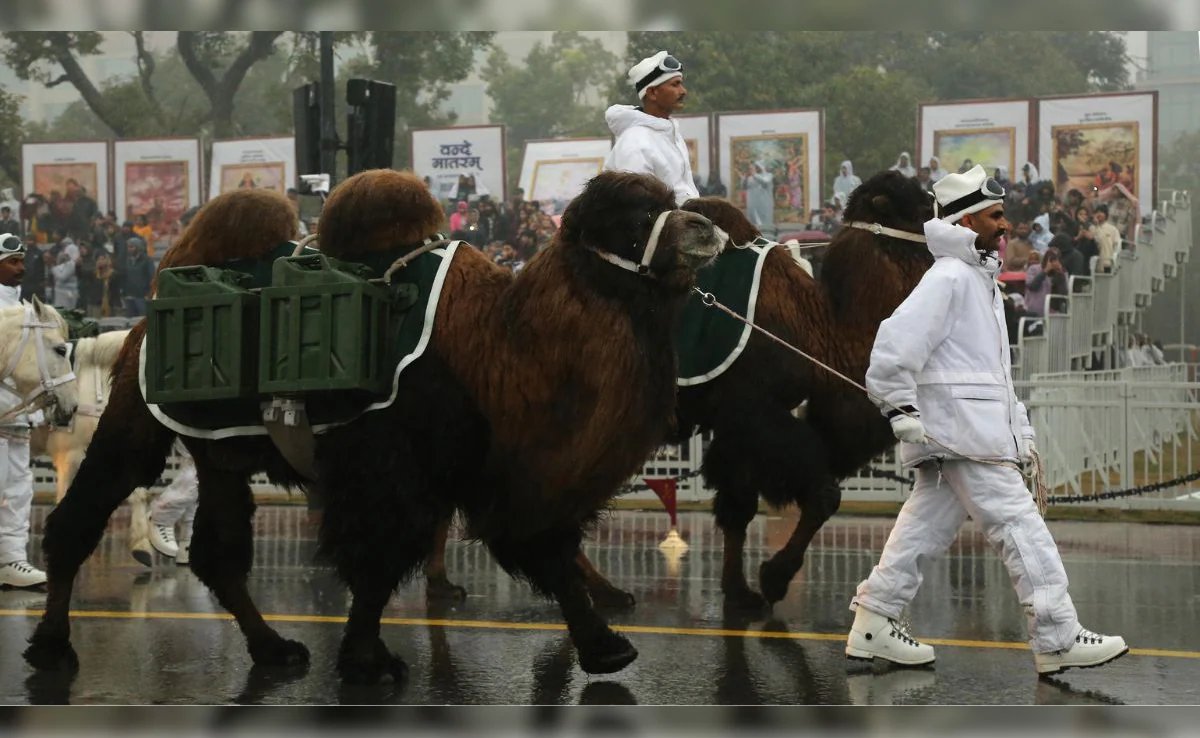
In a historic first for the Republic Day Parade, two majestic double-humped Bactrian camels named Galwan and Nubra will walk the ceremonial path.
A far cry from their native cold desert of Ladakh, these rare animals captivated the Delhi crowd on the day of the parade rehearsal not just for their exotic appearance, but for what they represent: India’s renewed reliance on hardy, high-altitude pack animals for military logistics in an era dominated by drones, robots and high-tech warfare.
The presence of Galwan and Nubra on the national stage marks the first time Bactrian camels have been showcased in the Republic Day parade. They began when the Indian Army formally began inducting these animals into service in eastern Ladakh, using them to transport supplies, ammunition and equipment in areas where machines often failed.
Speaking to NDTV in Leh, Colonel Ravikant Sharma, a veterinarian at the Defense Institute for High Altitude Research (DIHAR), explained their operational importance.
“These double-humped camels are specialized camels for high-altitude, arid environments,” he said. “They have been used for centuries in Central Asia and on the Silk Route. They can easily carry a load of up to 150 kg and travel 10 to 12 kilometers at an altitude of 14,000 to 15,000 feet.”
When asked if they make good herd animals for the Army, Colonel Sharma replied firmly, “They are proven herd animals. We want to use these camels for operational logistics for the Indian Army in eastern Ladakh.”
What makes the Bactrian camel so unique?
The double hump camel of Ladakh is one of the rarest camel species in the world. According to a report by DIHAR and the Animal Husbandry Department of Ladakh, only about 365 such camels exist in India, all of which are in the Nubra Valley region. They have evolved over millions of years to survive the brutal conditions of the high-altitude cold deserts of Central Asia.
Ladakh has an altitude of over 3,000 metres, where temperatures drop below minus 30 degrees Celsius in winter, intense UV radiation, low humidity and severe lack of vegetation. In these extreme conditions, few animals or machines can operate reliably. But the Bactrian camel, known locally as the Mundri camel, thrives.
Bactrian camels have special red blood cells (RBCs) that help them survive in low oxygen and harsh environments and it is this hardy nature that has made them much sought-after herd animals in the cold desert of Ladakh.
mystery of two humps
Much of his legendary stamina comes from his two distinctive humps. As Colonel Sharma explained, “Humps are basically fat storage depots. In extreme situations, when food is not available, they can mobilize energy and fat from these humps. They can go without food for two to three weeks.”
Research conducted by DIHAR has shown that each hump is composed of concentrated adipose tissue, which acts as an emergency energy bank during long journeys where food is scarce, especially in winter when Ladakh is covered with snow. As the animal stretches this stored fat, the hump noticeably shrinks and becomes softer. It’s not just an adaptation, it’s a living masterpiece. This allows Bactrian camels to survive for weeks without food, travel long distances without grazing, withstand temperatures below minus 40 degrees Celsius, low oxygen and low atmospheric pressure, and thrive in rocky, sandy or snowy terrain where wheels cannot turn. They also gain moisture in winter by eating snow, reducing their dependence on liquid water.
Studied by DRDO before induction
Before their induction into the Army, Bactrian camels were studied extensively by DRDO-DIHAR headquartered at Leh. The institute documented their physiology, stamina, dietary patterns, wool characteristics and stress markers to determine how much weight they could reliably carry at various altitudes.
In recent joint trials conducted at an altitude of 17,000 feet, these camels successfully carried 170 kg of weight, proving that they can outperform mules or ponies at extreme altitudes, where the army often struggles to maintain supply chains.
DIHAR scientists have since developed standard operating procedures (SOPs) for load carrying, winter feeding, health management, breeding practices and overall care, paving the way for their deployment in further areas.
Why does the military still need pack animals?
In the age of high-tech armies, the natural question arises: why use animals at all?
There are limitations to reliance on robots and drones. Drones can be jammed or shot down by anti-drone systems. Batteries deteriorate in extreme cold. Engines roar at altitude. Satellite links may be disrupted.
In contrast, animals such as the mule, yak and now the Bactrian camel remain dumb, dumb, reliable and immune to electronic warfare.
These camels provide the army with a non-technological, non-jammable logistics system, the ability to reach forward posts inaccessible by vehicles, quiet movement ideal for tactical operations and a sustainable option requiring minimal external supplies.
India’s strategic position in the high Himalayas, including eastern Ladakh, the Siachen approaches and forward posts along the Line of Actual Control, demands exactly such capabilities.
From Silk Route to Republic Day Parade
Historically, Bactrian camels were the lifeline of the ancient Silk Road, carrying salt, tea, spices, silk, carpets and precious metals across 6,400 km of rugged terrain. They first appeared in Ladakh in the late 19th century, brought by traders from Yarkand, present-day Xinjiang, China.
Today, they have been revived as both a tourism asset and a strategic military resource.
This is why the arrival of Galwan and Nubra in the Republic Day parade is more than ceremonial. It symbolizes India’s deep understanding that high-altitude warfare requires not only satellites and drones, but also the eternal strength of nature’s most resilient creatures.