
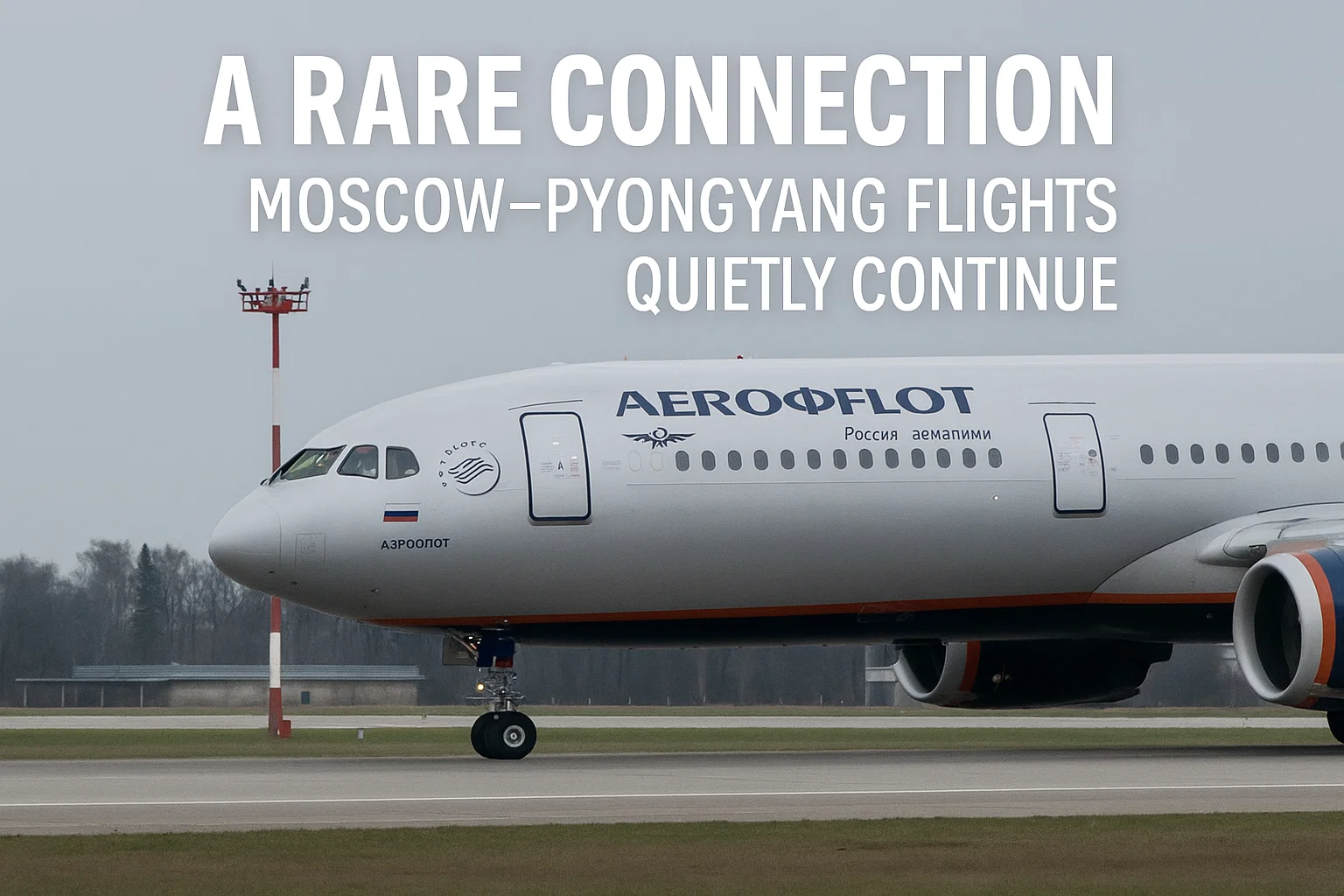
In late July 2025, one of the world’s rarest international air links quietly re-emerged. A single monthly flight by Nordwind Airlines now connects Sheremetyevo International Airport (SVO) in Moscow to Sunan International Airport (FNJ) in Pyongyang, North Korea. This unusual route, largely out of the public eye, signals significant shifts in aviation, geopolitics, and bilateral ties.
The first return flight under this new connection was scheduled for 31 October, a Friday evening departure from Moscow arriving in Pyongyang the next morning.
The revival of this route is steeped in strategic importance. It reflects the strengthened cooperation between Russia and the Democratic People’s Republic of Korea (DPRK), and it opens a corridor of travel, logistics and political signalling.
In this article we explore the context, details and implications of the Moscow–Pyongyang route: how it came about, how it operates, what this means for the airline and for the two nations — and finally what travellers and observers should know. We’ll include a helpful table of key route specifications, and finish with some frequently asked questions (FAQs).
1. The Route Resumes: Moscow to Pyongyang
The route between Moscow and Pyongyang has been dormant for decades. According to multiple sources, the flight is the first direct commercial connection between the two capitals in over 30 years.
The resumption came against the backdrop of deepening Russia-DPRK relations. With Russia increasingly isolated from Western airspace and financial systems following the 2022 invasion of Ukraine, Moscow has sought new partners. North Korea meanwhile sees value in stronger ties with Russia — both symbolically and practically. The new flight opens a transport corridor that bypasses many of the usual intermediaries.
The inaugural flight operated by Nordwind departed Moscow in late July, with tickets starting at 44,700 rubles (approx. USD 563) for the eight-hour journey. Northern news outlets emphasise that the flight will initially run once a month, although the regulatory approval allows up to twice weekly.
This route revival is both historic and strategically meaningful. According to Reuters:
“Russia has resumed direct passenger flights between Moscow and Pyongyang for the first time since the mid-1990s…”
So, what’s going on behind the scenes?
2. Why the Moscow–Pyongyang Flights?
2.1 Strategic and geopolitical motivations
The flight reflects growing cooperation between the two countries. Russia’s isolation from Western airspace means it must find alternative gateways and partnerships. North Korea offers Moscow one such partner that is not subject to the same alliances. According to reporting:
“The resumption of Moscow–Pyongyang flights comes amid a period of deepening political and economic cooperation between Russia and North Korea.”
While chiefly strategic, the route also has commercial dimensions. For instance, the ticket price (~44,600 to 45,000 rubles) suggests a premium service — and given the capacity (around 440 seats on a Boeing 777-200ER) the potential is significant.
2.3 Background: from holiday charters to political corridors
Nordwind Airline was founded in 2008, and until recently focused largely on leisure and charter routes between Russia and southern Europe, the Middle East and Asia. The shift to a route like Moscow-Pyongyang illustrates how the airline industry adapts to geopolitical change. For Nordwind, whose Western routes have been curtailed due to sanctions and the war, turning east has become a strategic necessity.
3. Route Details — How it Operates
Here is a summary of the key route specifications for the Moscow–Pyongyang link:
| Specification | Detail |
|---|---|
| Airline | Nordwind Airlines (N4/NWS) |
| Route | Moscow Sheremetyevo (SVO) → Pyongyang Sunan (FNJ) |
| Inaugural departure | ~27 July 2025 |
| Aircraft type | Boeing 777-200ER (440 seats) |
| Flight duration | ~8 hours |
| Frequency initially | Once a month (with potential to increase) |
| Starting fare | ~44,600-45,000 rubles (≈USD 560-570) |
| Purpose | Passenger route, official and logistics corridor |
| Context | Deepening Russia-DPRK ties, sanctions work-around |
This table encapsulates the key facts. The flight number listed in some sources is N46107 (Moscow to Pyongyang).
4. What It Means for Aviation and Beyond
4.1 Aviation industry implications
- The launch of this route is a major shift in the aviation map: the capitals of Russia and North Korea are now directly connected — something not seen for decades.
- For Nordwind, it is a pivot: from leisure charters to politically strategic international services.
- For Russia, it offers a route less subject to Western airspace constraints or sanctions.
- For North Korea, it presents a rare, visible gateway to Russia.
4.2 Geopolitical and economic significance
- The route underscores Moscow’s intent to diversify partnerships beyond the West, especially given constraints from sanctions and the war in Ukraine.
- It signals the deepening of Russia–North Korea ties — already under scrutiny because of alleged military cooperation.
- The flight could support logistics and cargo (official delegations, technical staff) in addition to passenger travel, thereby strengthening practical cooperation.
- The modest frequency (once a month initially) makes it symbolic and strategic rather than purely commercial — though that may change.
4.3 Travel and tourism aspects
While the principal driver may be political, there are tourism implications:
- North Korea has been gradually reopening to select foreign tourism, and this route might feed into those flows.
- Russian tourists may receive encouragement to travel via this route, especially given the resort developments in North Korea aimed at Russian visitors.
- For regular commercial travellers, this is an extraordinary and unusual route — hardly your typical vacation connection.
5. Challenges, Limitations and Considerations
There are a range of practical and strategic limitations to keep in mind:
- Low frequency: The route is scheduled once a month initially, which means limited availability and flexibility.
- High cost: With fares starting at ~44,600 rubles (~USD 560–570), this is not a budget travel option.
- Regulatory and sanctioned environment: Russia and North Korea are both under substantial Western sanctions, which complicates logistics, insurance, and fleet operations.
- Tourism restrictions in North Korea: Although North Korea has opened select tourism flows, general tourism is still restricted — so this flight may not serve typical open-tourism markets.
- Fleet and route viability: Operating a widebody 777 with 440 seats on a once-monthly frequency faces load-factor risks unless there is assured demand. Industry commentary notes uncertainty about whether this makes commercial sense yet.
6. The Airline: Nordwind Airlines’ Strategic Shift
Founded in 2008, Nordwind Airlines originally made its mark by operating charter and leisure services between Russia and holiday destinations in southern Europe, Middle East and Asia. With Western airspace and destinations now largely closed off due to sanctions and the war in Ukraine, Nordwind shifted focus eastwards.
The Moscow–Pyongyang route is emblematic of that pivot: a former holiday-charter carrier now operating a politically strategic route linking capitals in a geopolitical arc. The shift underscores how airlines evolve not only for commercial reasons but also to reflect national strategic interests.
7. Background: Moscow & Pyongyang — Historical Links
Historically, direct flights between Moscow and Pyongyang had existed but faded away:
- The route was last regularly served in the early 1990s by Aeroflot and earlier still by Soviet-era aircraft.
- In recent years, the only direct air link between Russia and North Korea was via the Russian Far East city of Vladivostok (VVO) to Pyongyang (FNJ) operated by Air Koryo.
The revival of the route therefore closes a decades-long gap in direct capital-to-capital air connections, highlighting the political dimension as much as the transport one.
8. Implications for Russian & North Korean Travel
8.1 For Russian travellers
- For Russian citizens willing or able to travel, this offers a unique route to North Korea, albeit under very specific conditions.
- Given Western travel restrictions and the shrinking of usual vacation destinations, Russian tourists are being encouraged toward non-Western destinations such as North Korea’s new resort developments.
- Logistic considerations (visa, accommodation, travel restrictions in North Korea) remain significant.
8.2 For North Korea
- The route gives North Korea a new international link beyond China and the Far East of Russia — potentially an avenue for more economic engagement, limited tourism, official travel and cargo.
- Symbolically, it underscores Pyongyang’s ability to re-engage beyond its isolation.
- But North Korea’s tourism and international engagement remain tightly controlled and limited, so outcomes may remain niche.
9. What to Watch Going Forward
Here are some key factors to monitor as this route develops:
- Frequency changes: Will the route expand beyond once a month? Approval exists for up to twice weekly.
- Load factors and passenger profile: Are these flights filled by tourists, delegations, technical staff or cargo?
- Economic viability: Can such a route sustain itself commercially or is it primarily strategic?
- Tourism implications: Will North Korea open more broadly to foreign tourists and channel that via this route?
- Geopolitical risks: Sanctions, airspace restrictions, fleet lease issues and changes in diplomatic alignment could affect the route viability.
- Cargo and technical usage: Beyond passenger service, can the route carry cargo, equipment and staff in support of bilateral cooperation?
10. Summary & Key Take-aways
In summary:
- The monthly flight by Nordwind Airlines linking Moscow and Pyongyang marks a significant revival after decades of no direct capital-to-capital service.
- The link is as much strategic and political as it is transport-oriented, reflecting deepening Russia–DPRK relations.
- For the aviation industry, this route signals how airlines and states respond to changing geopolitics and sanctions environments.
- For travellers and observers, the route is rare, high-cost and limited in availability — more emblematic than commercial for now.
- The future potential is intriguing: increased frequency, expanded tourism, cargo/logistic roles — but also hinge on broader developments.
11. FAQs – Moscow–Pyongyang Flights
Q1. Who operates the Moscow–Pyongyang flights?
A1. The flight is operated by Nordwind Airlines (IATA N4/NWS) between Moscow Sheremetyevo (SVO) and Pyongyang Sunan (FNJ).
Q2. How often do the flights run?
A2. Initially the route runs once a month. Approval exists for up to twice weekly depending on demand.
Q3. How long is the flight?
A3. The flight takes around eight hours, depending on routing and conditions.
Q4. How much does a ticket cost?
A4. Initial ticket fares were about 44,600-45,000 rubles (approximately USD 560-570) for one-way.
Q5. Why was this route started?
A5. The link is part of broader Russia–North Korea cooperation. For Russia, alternative routes to the West are limited; for North Korea, a direct link to Moscow expands its international connectivity.
Q6. Is this route open for general tourism?
A6. While the flight exists, tourism into North Korea remains highly regulated. The route at present appears to serve official, delegation and niche travel rather than broad mass-tourism.
12. Final Thoughts
The revival of the Moscow–Pyongyang flights stands as a unique case in global aviation. It brings together sport, politics, economics and travel in a way rarely seen. For the casual traveller, the route may not yet offer a standard commercial opportunity — but for observers of aviation and geopolitics, it is a window into how international networks evolve under pressure.
As we watch how the route develops — whether frequency increases, whether tourism flows emerge, whether cargo/logistics grow — one thing is clear: this flight is rare, strategic, and full of symbolic weight.
If you’re interested, I can also pull together a detailed timeline, map and flight number sheet, or comparison with other rare international routes (for e.g., DPRK–Russia, DPRK–Russia via Vladivostok) and we can embed that into the blog. Would you like that?
More Related Post