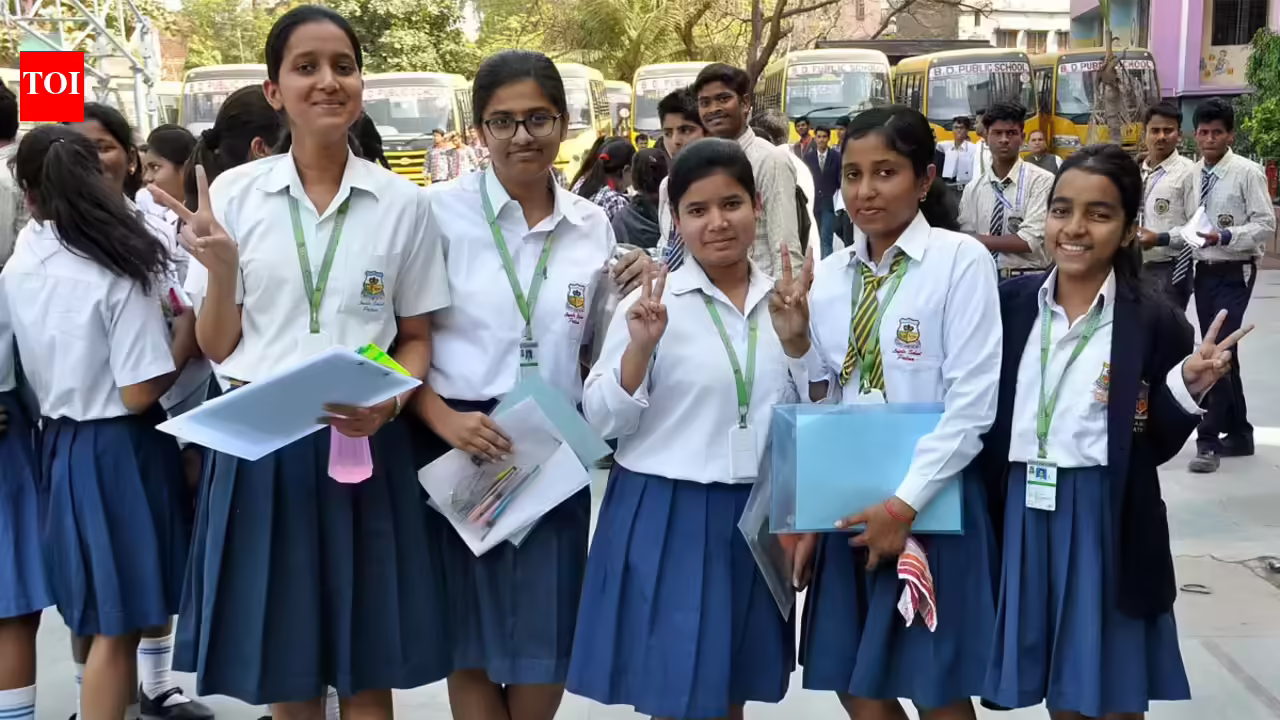
The Central Board of Secondary Education (CBSE) conducted the Class 10 Mathematics exam today, February 17, 2026, in both standard and basic formats. Initial reactions from students and teachers indicate a notable difference in the difficulty level between the two papers. While the Standard Paper was largely balanced and manageable, the Basic Paper was criticized for being long and challenging.Dr Alka Kapoor, principal, Modern Public School, shared with TOI, “The standard paper was balanced, well-structured and manageable within the allotted time, while the Basic paper was relatively difficult and lengthy, with graph-based questions proving particularly challenging.” Many teachers from across India also shared their analyses. Manpreet Kaur, TGT Mathematics at Global Indian International School, said, “The Class 10 Maths board exam paper was balanced and prepared as per the prescribed board pattern. Overall the difficulty was easy to moderate. Most of the questions were concept-based and straightforward, however triangle questions and probability questions were tricky. Time management was important, but well-prepared students could solve most of the questions confidently.Similarly, Suniti Sharma, TGT Mathematics at Global Indian International School, said, “The difficulty of the paper was moderate, with some sections leaning towards easy. The case-study and application-based questions, especially from trigonometry, required careful thinking. Students who had thoroughly practiced the NCERT examples found the paper manageable.” Vamanrao S Patil and Benasir PA of Jain International Residential School, Bengaluru described the paper as “moderate and largely NCERT-centric”. While MCQs and two-mark questions were accessible, Section D and Case-based Section E required in-depth analysis, careful reading and effective time management.Shafali Bhatt, HOD of Mathematics at DPS Sector 45, shared her expert view on the exam: “The Class 10 Mathematics exam, both standard and basic, was well-structured and strictly aligned with the NCERT syllabus. The paper was balanced in difficulty, covering all the key concepts to a great extent. Importantly, no questions were outside the prescribed syllabus, and both papers maintained consistency in structure and conceptual clarity, effectively assessing students’ understanding and application skills without being unpredictable.“ Students also expressed their views. Class 10 student Abhishek Sen said, “Paper set 430/2/2 was extremely long and difficult too, especially since it was a basic paper. CBSE should shed its arrogance and re-conduct the examination and this time set the difficulty level at par with the basic level.“The Basic paper required extensive calculations, while the Standard paper tested conceptual clarity without being too lengthy,” said Sanjay Sharma, a teacher at Yamuna Vihar.Competency-based questions test conceptual clarityOne of the highlights of this year’s paper was the presence of aptitude-based questions. Teachers noted that these questions require students to apply concepts rather than relying solely on memorization.PGT Mathematics Mr. Abhishek Mehra said, “Aptitude-based questions were thoughtfully designed. They tested students’ understanding of concepts in real-life contexts.” “CBSE is clearly moving towards assessing application skills.”In particular, some word problems and case-study based questions require step-by-step reasoning. Students who practiced the simulated problems reportedly found them manageable.Challenging Area: Circle and Long MCQsWhile the overall paper was accessible, early reviews of the Basic Mathematics paper highlighted that some questions in the ‘Circles’ chapter posed challenges. Some students felt that these questions required deep conceptual understanding.Another student from Yamuna Vihar said, “I was a little confused in one question on Circles, but after reading it again, I was able to attempt it.”Additionally, a section of multiple choice questions (MCQs) was reported to be lengthy. Although not necessarily difficult, these questions require time and careful calculation. Therefore, time management played an important role. Another student from Mumbai told TOI, “Section E was difficult while the rest of the paper was moderate. Many students looked stressed, and some were even crying after coming out of the exam hall.”“what lies aheadWith the beginning of board exams with Mathematics, students are feeling relieved and hopeful about the upcoming subjects. As the board exams progress, expert analysis and actual question papers are expected to be released soon.Overall, the Central Board of Secondary Education (CBSE) Class 10 Mathematics Paper 2026 has been said to be moderately difficult, with a mix of direct and application-based questions. Although some students found the paper manageable with proper preparation, certain parts of the paper demanded a better understanding of concepts and time management. Despite its difficulties, the paper was found to be fair and in line with the syllabus, marking a steady start to this year’s board exams.In conclusion, while the Standard Paper was largely fair and student-friendly, the Basic Paper challenged many learners. Competency-based and application-driven questions tested conceptual understanding and time management. Students and teachers are now analyzing both the papers to assess the performance and prepare for the upcoming subjects.