
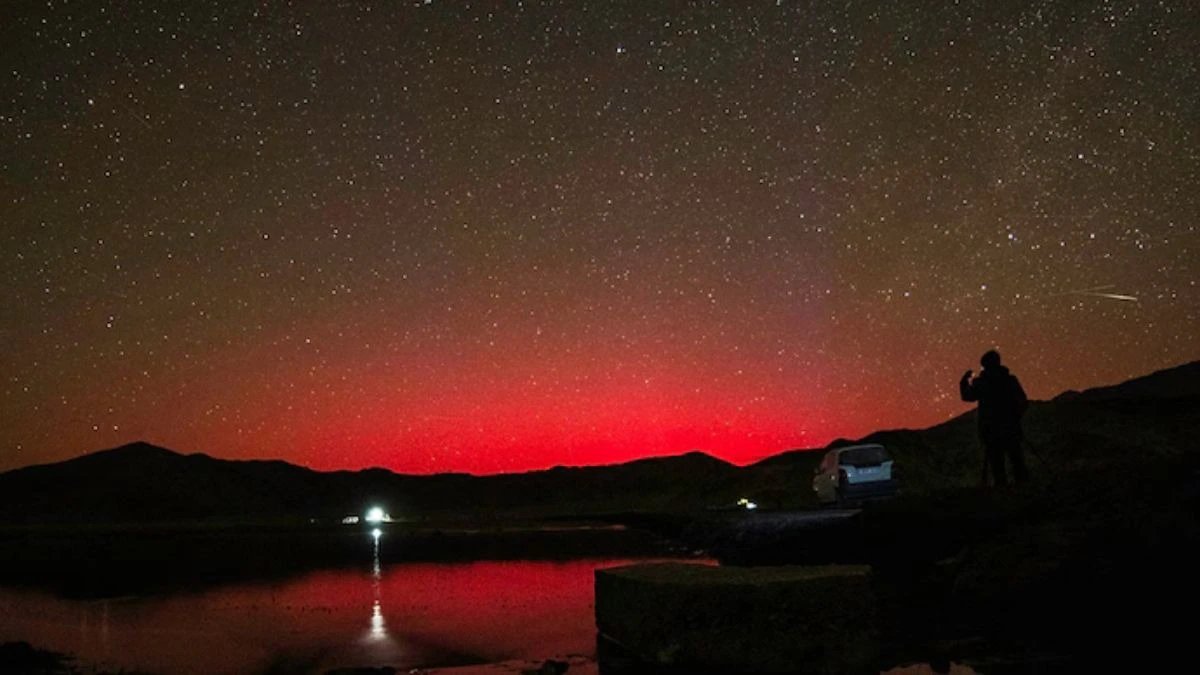
The night sky in Hanle, Ladakh is usually a canvas of deep sapphire, punctuated only by the piercing light of distant galaxies. However, on the night of 19 and 20 January, this darkness was broken by an eerie, blood-red glow.
While social media is awash with mesmerizing images of these northern lights in India, the scientific reality is far more sobering. These views are not just beautiful pictures; They are direct signatures of a Sun that is becoming increasingly unstable.
How does solar storm reach India?
The red auroras seen from Henley Dark Sky Reserve were caused by the most intense solar radiation storm since 2003.
On January 18, an It is a giant bubble of solar gas and magnetic field that the Sun throws into space at high speed.
The plasma cloud rushed towards Earth at a speed of 1,700 kilometers per second, and reached our atmosphere in just 25 hours.
When these particles collided with our planet’s magnetic field, they triggered a G4-level geomagnetic storm.
A geomagnetic storm is a major disruption of Earth’s magnetic shield that occurs when the solar wind interacts with the space environment surrounding our planet.
The red color comes from high-altitude oxygen atoms being excited by solar particles, particularly at altitudes over 300 kilometers.
At lower latitudes, such as Ladakh, we see the tops of these curtains appear red rather than the green typically seen in polar regions. According to recent reports from ISRO, these events are becoming more frequent as we approach solar maximum.
Is our digital infrastructure at risk?
While Henley Observatory captured these waves with its celestial camera, beauty dons the mask of a beast.
This January 2026 event was an S4 severe radiation storm, an intense flow of high-energy protons from the Sun. Both NASA and ISRO have monitored how these events compress Earth’s magnetic shield.
Recent data from the Aditya-L1 mission has shown that such storms can push our magnetic boundary so close to the surface that geostationary satellites are exposed to harsh solar winds for some time.
For a country like India, which is rapidly expanding its digital economy, this is a high-risk game.
Strong geomagnetic storms can cause electrocutions in power grids, causing blackouts. They also extend the upper atmosphere, creating drag that can pull satellites out of orbit.
Our GPS navigation and banking systems are all in question. During this latest storm, astronauts on the International Space Station (ISS) also had to take shelter due to elevated radiation levels.
How do we make a shield?
The solution to these aerial threats lies in advanced forecasting and flexible engineering.
India is currently strengthening its space weather forecasting through the Aditya-L1 mission, which acts as a sentry over the L1 Lagrange point.
By detecting coronal mass ejections before they reach Earth, scientists can give 24 to 48 hours warning. This allows satellite operators to keep spacecraft in safe mode and power grid managers to balance loads to prevent transformer fires.
At the ground level, the solution includes strengthening our national power grid. Engineers are installing geomagnetically induced current sensors to monitor real-time threats.
Other than this, IThe Indian Astronomical Observatory, located at the heart of the Hanle Dark Sky Reserve, plays a vital role by providing ground-based data that helps validate satellite observations.
Protecting the Henley Dark Sky Reserve from light pollution is essential, as it ensures that our optical sensors remain sensitive enough to detect the slightest changes in the upper atmosphere.
How do we preserve the darkness to see the light?
These scenes also highlight the precarious nature of the Hanley Dark Sky Reserve. As India’s first designated Dark Sky Sanctuary, Hanle offers a rare window into the universe.
But as tourism increases, light pollution threatens to cause these scientific signs to disappear. If we lose Hanley’s darkness, we lose our early warning system for space weather that determines the health of our planet’s technological heart.
The red sky is a majestic sight, but it is also a reminder. As we admire the glow, we must not ignore this message: Our Sun is awakening, and our electronic world is more fragile than we want to admit.
– ends