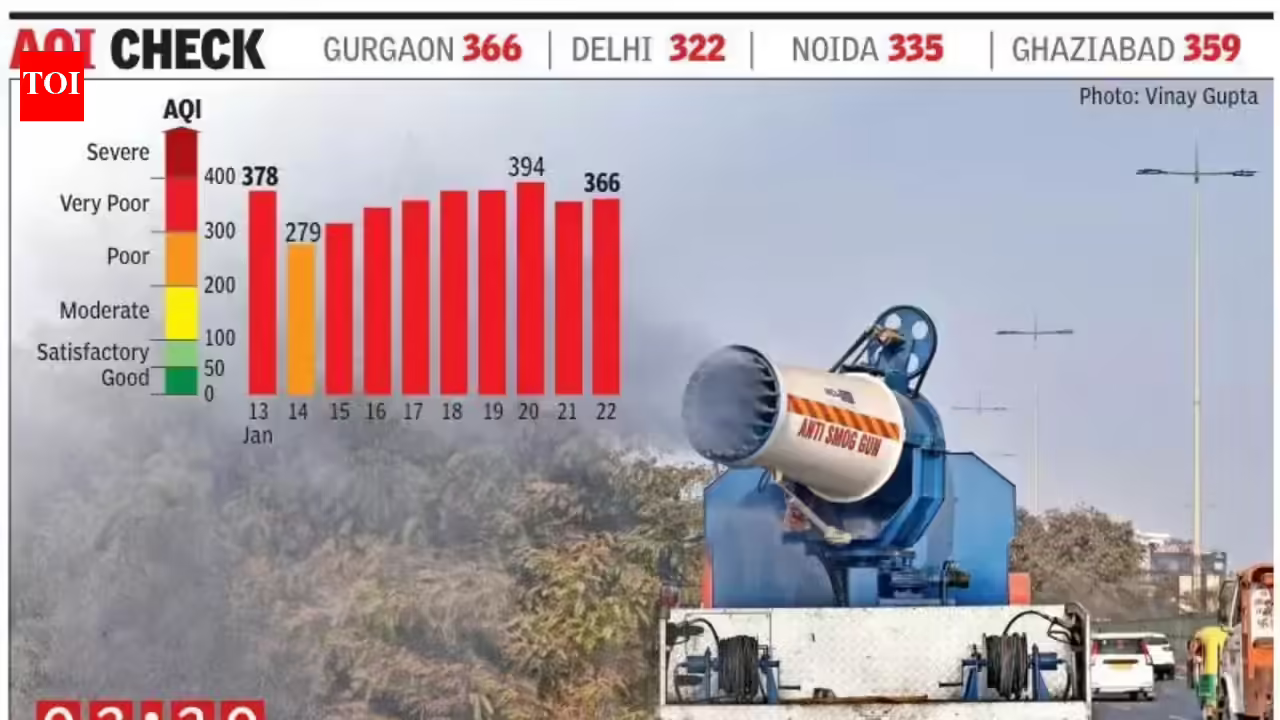
Gurgaon: After an unusually hot January day, the IMD has warned of light rain, thunderstorm and gusty winds up to 40 kmph in parts of the city on Friday morning. The maximum temperature recorded on Thursday was 23.2 degrees Celsius. The IMD said maximum temperatures across Haryana were “well above normal”, with the state’s average maximum temperature rising by 0.6 degrees Celsius from the previous day and standing 4.8 degrees Celsius above normal.Air quality in the city remained in the ‘very poor’ category for the eighth consecutive day on Thursday, with the overall air quality index standing at 366, while two monitoring stations recorded ‘severe’ pollution levels, indicating persistently toxic zones across the district.Two of the three active monitoring stations reported AQI readings above 400, which falls in the ‘severe’ category at the national level. AQI was recorded at 405 in Vikas Sadan and 402 in Sector 51. The IMD station in Gwal Pahari recorded a comparatively lower AQI of 291.The day-wise pollution chart for January showed that PM2.5 levels remained consistently high, with several days crossing 300 and some days exceeding 370, indicating prolonged persistence of fine particle pollution. The city-level AQI was 358 on January 21, 394 on January 20 and 379 on January 19.PM2.5 is considered one of the most harmful pollutants as it can penetrate deep into the lungs and enter the bloodstream.Doctors said continued exposure to such levels of pollution can cause breathing difficulties, cough, eye irritation and headaches. Children, the elderly, and people with asthma or heart disease are at greater risk. Residents in several sectors have reported avoiding outdoor activities due to poor air quality.Experts have blamed the poor air quality on winter conditions such as low wind speeds and temperature inversions, which trap pollutants closer to the surface even when emissions remain unchanged.Meanwhile, environmentalists said strict monitoring is needed to curb dust, construction-related violations and vehicular emissions during the sharp rise in pollution. The Central Pollution Control Board (CPCB) classifies AQI levels between 0 and 50 as ‘good’, 51 and 100 as ‘satisfactory’, 101 and 200 as ‘moderate’, 201 and 300 as ‘poor’, 301 and 400 as ‘very poor’ and 401 and 500 as ‘severe’.According to the Decision Support System (DSS) forecast, Delhi and NCR will remain generally cloudy over the next two days with light rain accompanied by thunderstorm or lightning and gusty winds, which may help in containing the spread. The air quality is likely to remain ‘very poor’ on January 22, improve to ‘moderate’ from January 23 to January 24 and remain ‘poor’ on January 25. The scenario in the following days will remain from ‘bad’ to ‘very bad’.Officials said the spread of pollutants remains limited due to adverse ventilation conditions. The ventilation index is expected to remain low on January 22, which is considered unfavorable for the spread, especially when the wind speed remains below 10 kmph.