
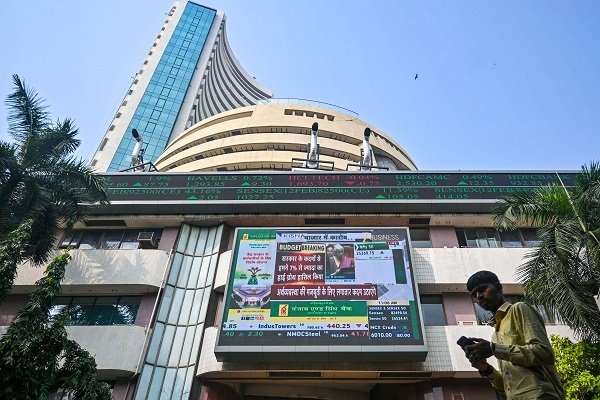
Indian equity benchmarks closed lower for the fifth consecutive week amid persistent geopolitical tensions, higher crude oil prices and continued foreign outflows.
Nifty declined by 1.28 per cent during the week and closed the last trading day at 22,819 with a decline of 2.09 per cent. At the end, Sensex was at 73,583, down 1,690 points or 2.25 per cent. It declined by 1.27 percent during the week.
Both indices remained volatile and under pressure throughout the week, although they attempted intermittent improvements during the week.
Bank Nifty underperformed the broader market and closed 2.67 per cent lower at 52,274 on Friday. It recorded a huge weekly decline of about 2.16 percent.
The main problem remains the ongoing geopolitical uncertainty surrounding the US-Iran conflict, making the market highly event-driven.
Concerns over disruption in global energy supplies remain, with Brent crude prices hovering in the $98-$115 range, keeping inflation expectations and overall macro stability under pressure.
Sector-wise, Nifty Metal and PSU Bank emerged as top losers on weekly basis. Nifty IT and Pharma were the only weekly gainers, rising 1.17 per cent and 0.11 per cent respectively.
Broader indices performed in line with the benchmark indices during the week, as Nifty Midcap100 declined 1.38 per cent, while Nifty Smallcap100 declined 0.63 per cent.
The Indian rupee weakened further, crossing the 94-mark against the US dollar, reflecting stress from higher crude oil prices and persistent capital outflows.
Vineet Bolinjkar, Head of ResearchVentura predicted range-bound action in the markets and pushed the VIX higher until global risk sentiment eased. “Strong domestic flows and any easing of tensions should limit downside, leading to quality large-cap and domestic themes on high-beta plays,” he said.
Market participants said the Nifty 50 index is currently trying to settle in the 22,850-22,750 zone, showing early signs of consolidation after the recent decline. “Immediate resistance is located at 23,000-23,100 areas,” he said.
Market participants said that for Bank Nifty, 52,000-51,800 zone is seen as immediate support level followed by 51,500-51,000 levels. He said that on the positive side, 3,000-53,600 acts as immediate resistance.
One analyst said higher oil prices are expected to continue to weigh on the market, while any declines could lead to short-covering and support a rebound.
On Friday, FIIs increased their aggressive selling in Indian equities, leading to net outflows of around Rs 25,000-30,000 crore during the week.
March month-to-date outflows surged to over Rs 1.13 lakh crore, the sharpest single-month outflow in FY2016. DIIs protested strongly with net purchases of over Rs 25,000 crore on a weekly basis.