
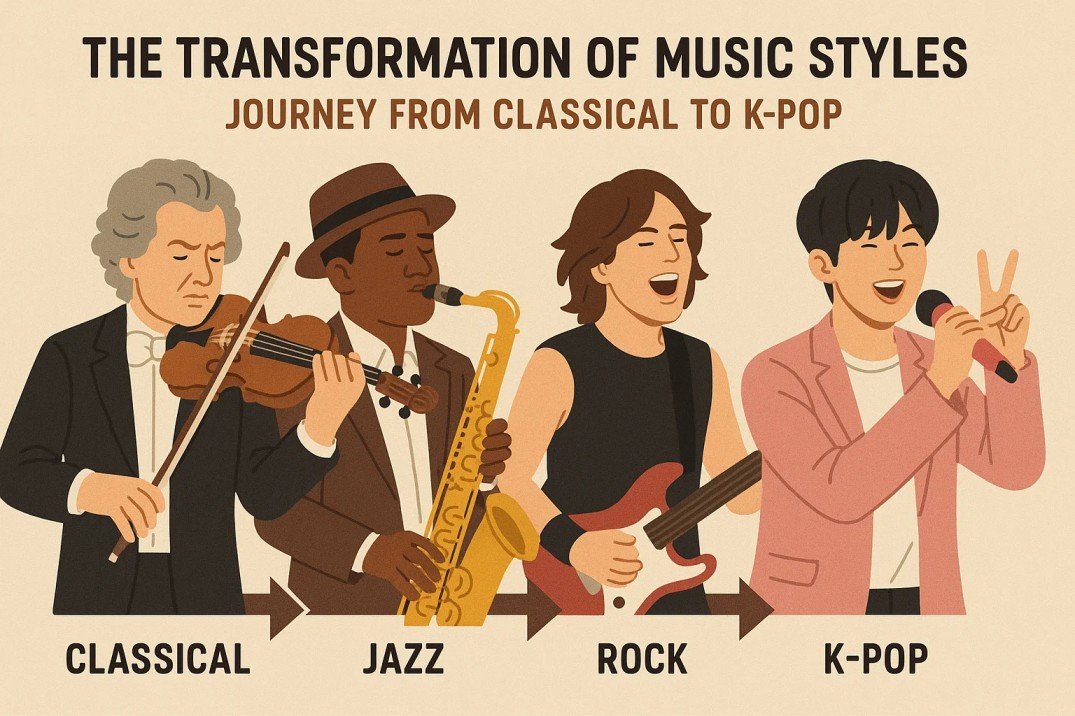
Music is more than just sound — it’s emotion, culture, and identity. Over centuries, the transformation of music styles has mirrored human civilization’s evolution. From the divine compositions of classical symphonies to the rhythmic beats of K-Pop, every era has left its signature note in history.
The transformation of music styles reflects how technology, social movements, and globalization have continuously shaped what we listen to. Let’s embark on a melodic journey — from the harmonious world of classical music to the global dominance of K-Pop.
1. The Roots of Music: The Classical Era
The classical era (roughly 1750–1820) was the foundation upon which much of modern music stands. Composers like Mozart, Beethoven, and Haydn emphasized structure, harmony, and emotional depth.
Music was often performed in royal courts or grand theaters, with orchestras symbolizing sophistication. The transformation of music styles began here, focusing on the balance between melody and harmony.
Key features of Classical Music:
- Emphasis on orchestral instruments (violin, piano, flute)
- Symmetrical melody and harmony
- Composed for the elite and upper class
- Structured in sonatas, concertos, and symphonies
Even today, film scores and instrumental arrangements borrow heavily from classical traditions — proving its timeless influence in the transformation of music styles.
2. The Birth of Jazz: Music of Freedom and Soul
In the early 20th century, Jazz emerged in the African-American communities of New Orleans. With its improvisational spirit, jazz represented freedom, resilience, and creativity. Artists like Louis Armstrong and Duke Ellington turned jazz into a cultural revolution.
This was a major turning point in the transformation of music styles, as emotion overtook structure. Jazz broke boundaries — introducing rhythm, syncopation, and spontaneous expression.
Why Jazz transformed music forever:
- It introduced improvisation as a core principle.
- Inspired other genres like rock and pop.
- Encouraged individuality and expression.
- Became a symbol of social and cultural change.
Jazz didn’t just change sound; it redefined how artists connect with audiences — creating a pathway for later revolutions in rock and pop.
3. The Rock Revolution: Youth, Energy, and Rebellion
The 1950s to 1980s marked the rock era, a time when music became the heartbeat of youth culture. Influenced by jazz and blues, rock music gave rise to legends like The Beatles, Elvis Presley, The Rolling Stones, and Queen.
The transformation of music styles here was driven by electric guitars, drums, and powerful lyrics that voiced rebellion, love, and freedom. Rock symbolized a shift in attitude — from formal to fearless.
Highlights of the Rock Transformation:
- Electric instruments became central.
- Concert culture and live performances exploded.
- Music became a form of protest and identity.
- Influenced fashion, language, and politics.
Rock and roll’s energy changed the world’s soundscape. It showed how music could drive social change — a theme that continues in today’s genres.
The Rise of Pop: Simplicity Meets Global Appeal
The late 20th century brought forth pop music, short for “popular music.” The term describes songs that appeal to the masses — catchy, melodic, and relatable.
Icons like Michael Jackson, Madonna, Whitney Houston, and Prince dominated this era. Pop made music universal — everyone could sing, dance, and connect.
How Pop Shaped the Transformation of Music Styles:
- Combined elements of rock, soul, and dance.
- Relied heavily on media and TV (MTV revolution).
- Focused on production quality and melody.
- Expanded globally through the rise of the internet.
Pop simplified music’s complexity while maximizing its emotional reach — a move that prepared the world for digital-age genres like K-Pop.
5. Hip-Hop and Rap: The Voice of the Streets
The late 1970s saw another cultural explosion — Hip-Hop and Rap. Originating in the Bronx, New York, it became the music of resistance and empowerment.
Artists like Tupac Shakur, The Notorious B.I.G., Eminem, and Jay-Z gave rhythm to stories of struggle, hope, and triumph. The transformation of music styles accelerated as lyrics became the new melody.
Key Aspects of Hip-Hop Evolution:
- Focused on lyrical storytelling.
- Introduced beatboxing, sampling, and DJ culture.
- Reflected real-life experiences and urban struggles.
- Became a global lifestyle, not just a genre.
Hip-hop proved that words could be just as powerful as melodies — and it paved the way for global crossovers.
The Digital Revolution: Technology and Streaming
The 21st century completely redefined the transformation of music styles through technology. From CDs and MP3s to Spotify and YouTube, digital platforms transformed how music was created, shared, and consumed.
Artists were no longer dependent on record labels. Independent musicians could reach millions with a single upload. Auto-tune, electronic synthesizers, and computer-generated beats became the new instruments.
Digital Age Impact Table:
| Aspect | Before Digital Revolution | After Digital Revolution |
|---|---|---|
| Music Distribution | Physical CDs, Vinyls | Streaming platforms |
| Artists’ Reach | Local/National | Global (via Internet) |
| Music Creation | Studio-based | Home-based with software |
| Audience Feedback | Slow (radio, sales) | Instant (social media) |
| Revenue Source | Album Sales | Streams, Ads, Merch |
Technology democratized the music world — enabling diversity and innovation in every corner of the globe.
7. The Global Wave of K-Pop: The Modern Phenomenon
Today, the transformation of music styles has reached its peak with the global domination of K-Pop (Korean Pop). What began as a regional genre in South Korea has become a worldwide sensation.
Groups like BTS, BLACKPINK, EXO, and Twice have redefined how the world perceives music, fashion, and performance. K-Pop represents the perfect fusion of music, visual storytelling, and fan culture.
What Makes K-Pop Unique:
- High production quality and choreography.
- Multilingual songs with international appeal.
- Interactive fan culture through social media.
- Blend of electronic, hip-hop, and pop influences.
K-Pop’s rise shows how music evolution is now borderless. A Korean song can top charts in the U.S., Europe, and India — proving that sound truly has no language.
8. The Cultural Impact of Music Transformation
As music evolved from classical to K-Pop, it didn’t just change sound — it transformed society.
- Classical music symbolized discipline and structure.
- Jazz and Rock embodied freedom and rebellion.
- Pop and Hip-Hop reflected identity and individuality.
- K-Pop represents globalization and unity.
The transformation of music styles has continuously mirrored humanity’s emotional and technological growth. It shows that while instruments and platforms may change, music’s essence — emotion — remains constant.
9. Fusion and Hybrid Genres: The Future of Music
Modern musicians now experiment with blending genres. Classical-electronic fusions, jazz-rap collaborations, and K-Pop-reggae mixes define today’s sonic landscape.
AI-generated compositions and virtual artists are further changing the meaning of creativity. The next step in the transformation of music styles could involve complete integration between human emotion and artificial intelligence.
10. Summary Table: Evolution of Music Styles
| Era | Genre | Key Characteristics | Notable Artists |
|---|---|---|---|
| 1750–1820 | Classical | Harmony, orchestral, structured | Mozart, Beethoven |
| 1900s | Jazz | Improvisation, rhythm, freedom | Louis Armstrong |
| 1950s–1980s | Rock | Energy, rebellion, electric guitar | The Beatles, Queen |
| 1980s–2000s | Pop | Catchy, emotional, global appeal | Michael Jackson, Madonna |
| 1970s–Present | Hip-Hop | Rap, beats, storytelling | Tupac, Eminem |
| 2010s–Present | K-Pop | Performance, global fan base | BTS, BLACKPINK |
FAQs – Transformation of Music Styles
Q1. What is meant by the transformation of music styles?
A1. It refers to how music genres evolve over time, influenced by culture, technology, and emotion — from classical to modern forms like K-Pop.
Q2. Which was the first major transformation in music?
A2. The shift from structured classical music to free-flowing jazz marked the first big change in modern music evolution.
Q3. How has technology affected the transformation of music styles?
A3. Technology enabled global access, streaming, digital production, and faster audience feedback — reshaping how music is made and shared.
Q4. Why is K-Pop considered a major part of modern music evolution?
A4. Because K-Pop blends multiple genres, languages, and cultures, representing the globalization of modern music.
Q5. Will classical music ever disappear?
A5. No. Classical music remains the foundation for composition, film scores, and musical training worldwide.
Q6. What is the future of the transformation of music styles?
A6. The future will include AI-generated sounds, fusion genres, and global collaboration — proving music’s limitless adaptability.
Conclusion
The transformation of music styles from classical to K-Pop is not just a story of sound — it’s a story of humanity. Each era reflects society’s hopes, struggles, and innovations. From the disciplined elegance of Mozart to the digital choreography of BTS, music continues to evolve, connect, and inspire.
As technology and culture merge, one truth remains — music will always be the universal language of emotion.
More Related Post